Why Injection Blow Molding Produces Better Neck Accuracy Than Extrusion Blow Molding
For bottles used in pharmaceuticals, healthcare, cosmetics, and food packaging, the neck is often the most critical functional area. Its thread profile, sealing surface, diameters, and concentricity determine whether a cap, dropper, pump, or plug fits correctly. Even a visually perfect bottle can fail if its neck dimensions vary. Compared with extrusion blow molding, injection blow molding generally offers a more direct and repeatable way to manufacture this precision feature.
The Neck Is Injection Molded Before the Bottle Is Blown
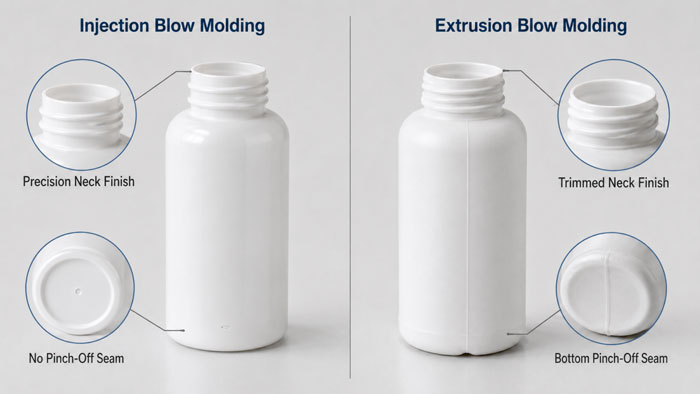
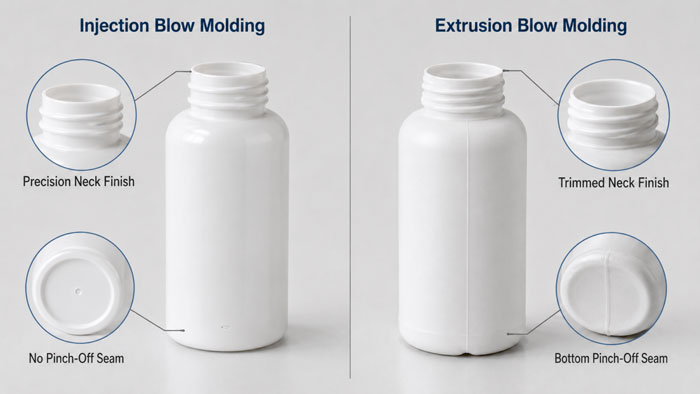
The main difference begins with how the preform is produced. In injection blow molding, molten polymer is injected into a precision preform mold around a core rod. The neck, threads, sealing land, and opening are formed during this injection stage by rigid steel tooling. The preform is then transferred, while still supported by the core rod, to the blow mold. Air expands only the hot body section into the final bottle shape.
Because the neck has already been injection molded, it is not created mainly by stretching an unsupported tube with air. Its dimensions come from the accurately machined relationship between the neck cavity and core rod. This is especially valuable for small bottles with fine threads, narrow openings, snap-fit closures, or automatically assembled components.
In extrusion blow molding, a continuous parison is extruded between two mold halves. The mold closes around it, and a blow pin introduces air to form the container. The process is highly productive and flexible, particularly for larger or handled containers, but the neck-forming sequence is more dependent on parison condition, mold closing, blow-pin action, and removal of excess material. Each additional influence creates another possible source of dimensional variation.
Rigid Tooling Improves Repeatability
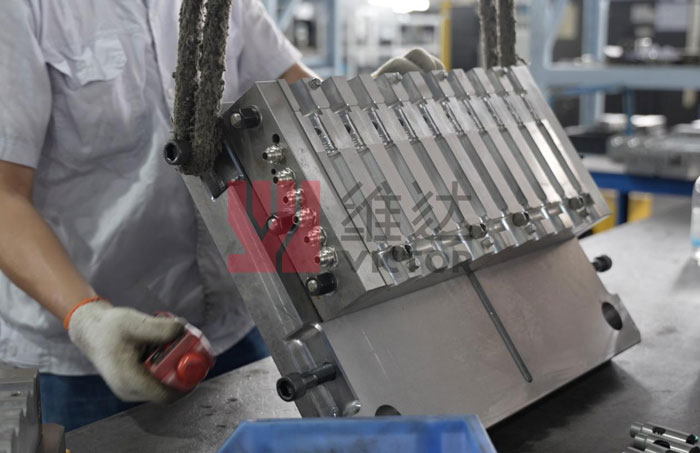
Injection pressure forces the material to reproduce the detailed geometry of the neck mold. Thread roots, thread crests, tamper-evident features, and sealing surfaces can therefore be defined with the same controlled tooling principles used in injection molding. The core rod also establishes the bore and supports the preform during transfer, helping the neck remain round and concentric.
This control matters in multi-cavity production. If cooling, injection volume, and mold temperature are stable, every cavity can repeatedly produce the same neck dimensions. The process can then be validated through measurements such as thread diameter, neck height, opening diameter, and cap torque.
Extrusion blow molding can also produce good necks, and advanced machines use precise blow pins, neck inserts, and deflashing systems. However, the extruded parison is affected by melt strength, die swell, temperature distribution, hanging time, and thickness variation. When the mold closes, the material must be captured and shaped consistently. Flash or a neck moil may then need trimming. Tool wear, cutter setup, or trimming variation can affect the top surface and sealing quality.
Less Secondary Finishing, Fewer Sources of Error
A major practical advantage of injection blow molding is that it typically produces a finished neck without trimming. This removes risks such as uneven cuts, burrs, plastic particles, damaged threads, or inconsistent bottle height. It also simplifies inspection and reduces handling between molding and filling.
This is important for pharmaceutical and medical packaging, where cleanliness and closure integrity are closely controlled. A smooth, repeatable sealing land supports reliable cap application and helps reduce the chance of leakage. For eye-drop bottles, diagnostic reagent bottles, tablet containers, and other precision packages, stable neck dimensions also improve the assembly of nozzles, plugs, and child-resistant or tamper-evident closures.
On an automated line, accurate neck geometry offers benefits beyond sealing. Bottles can be guided by the neck, transferred through star wheels, oriented, filled, and capped at high speed. Reduced dimensional variation means fewer jams, rejected caps, torque alarms, and line adjustments.
Process Control Still Determines the Final Result
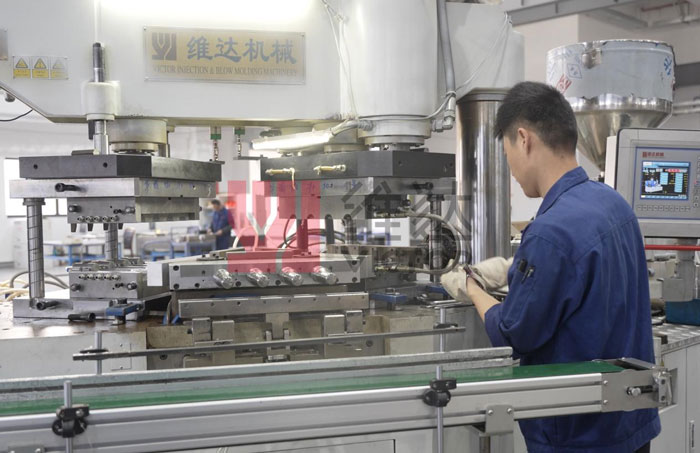
Injection blow molding has an inherent advantage in neck accuracy, but good results are not automatic. The preform mold, core rods, neck inserts, and transfer system must be manufactured and maintained precisely. Balanced injection, uniform cooling, correct resin drying, stable melt temperature, and consistent cycle timing are also essential. Core-rod temperature control is particularly important because it influences preform cooling, material distribution, and dimensional stability.
Manufacturers should inspect neck dimensions by cavity, monitor cap application torque, and maintain tooling before wear becomes visible. A capable machine with repeatable clamping, injection, and transfer movements keeps those controls effective over long runs.
Extrusion blow molding remains the better choice for many large, complex, or economical hollow products. Yet when a package requires a highly accurate molded neck, minimal finishing, clean production, and reliable closure assembly, injection blow molding usually provides the stronger process route. By forming the neck as a precision injection-molded component first and blowing only the container body afterward, it separates the most dimensionally sensitive feature from the less controlled stretching stage. That fundamental process difference is why injection blow molding consistently delivers superior neck accuracy for small and medium-sized precision bottles.