Injection Blow Molding vs Extrusion Blow Molding: Which Process Is Better for Medical Packaging?
Introduction
The medical packaging industry operates under extremely strict standards of precision, sterility, and reliability. The integrity of packaging directly affects patient safety, drug efficacy, and regulatory compliance. Among the manufacturing processes used to produce plastic medical packaging—such as vials, bottles, syringes, and diagnostic containers—blow molding is one of the most versatile and cost-effective methods.
Two major blow molding technologies are widely used in this field:
- Injection Blow Molding (IBM)
- Extrusion Blow Molding (EBM)
Although both processes can manufacture hollow plastic products, their differences in precision, cleanliness, material compatibility, and production stability make them suitable for different applications. For medical packaging, where accuracy and sterility are essential, Injection Blow Molding is generally the better choice.
Basic Differences Between IBM and EBM
What is Extrusion Blow Molding (EBM)?
Extrusion Blow Molding works by melting plastic resin and extruding it into a continuous hollow tube called a parison. This parison is then clamped into a mold and inflated with compressed air until it takes the shape of the mold cavity.
This method is relatively simple and cost-effective, especially for large-volume production of containers with less demanding precision requirements.

What is Injection Blow Molding (IBM)?
Injection Blow Molding combines two core steps:
- Injection molding a preform with precise neck and thread details
- Transferring the preform into a blow mold, where compressed air expands it into the final shape
This process is typically automated through a three-station or four-station system. Because the neck finish is formed during the injection stage, IBM achieves significantly higher dimensional accuracy and product consistency.
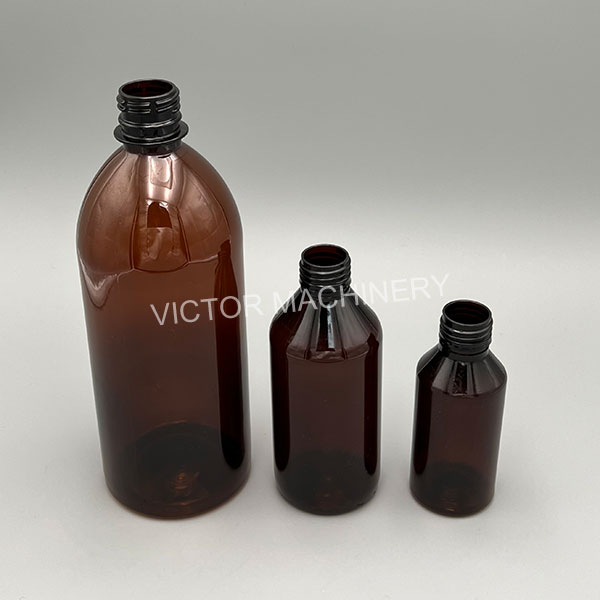
Advantages of Injection Blow Molding Compared to Extrusion Blow Molding
1. Superior Precision and Consistency
One of the most important requirements in medical packaging is the ability to create containers with highly accurate dimensions, especially in the neck, thread, and sealing area.
In medical applications, containers must often be sealed with:
- screw caps
- rubber stoppers
- septa
- tamper-evident closures
Any inconsistency in neck diameter, thread shape, or sealing surface can lead to:
- leakage
- contamination
- moisture ingress
- reduced drug stability
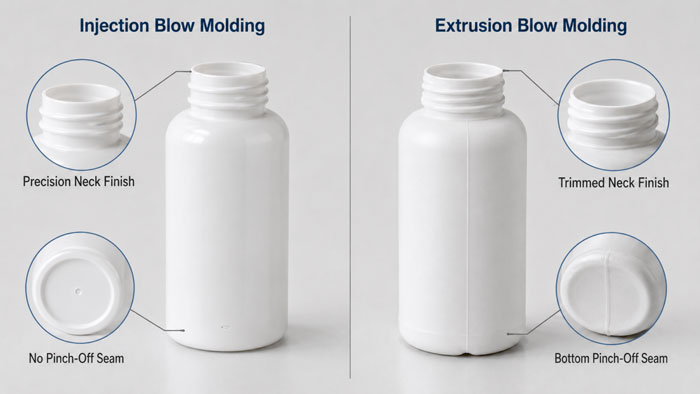
In EBM, the neck is formed during the clamping and blowing stage, which can result in:
- inconsistent neck dimensions
- uneven thread formation
- irregular sealing surfaces
In contrast, IBM forms the neck and threads during the injection molding step, using a precision-machined mold under high pressure. This produces:
- highly consistent neck finishes
- smooth and accurate threads
- flat, uniform sealing surfaces
- better closure compatibility
This precision is particularly important for pharmaceutical bottles, injectable vials, and diagnostic containers.
In addition, IBM produces containers with more uniform wall thickness. This reduces weak points and improves the product’s resistance to:
- handling stress
- sterilization conditions
- transportation damage
2. Better Sterility Control and Lower Contamination Risk
Sterility is one of the most critical requirements in medical packaging. Manufacturers must comply with Good Manufacturing Practices (GMP) and often operate in clean room environments.
EBM presents several contamination challenges:
- the extruded parison is exposed to the surrounding environment before molding
- the process generates excess plastic waste
- trimming is often required after molding
- post-processing may introduce dust, particles, or debris
These factors increase contamination risk, which is a serious disadvantage for medical packaging.
By contrast, IBM uses a more closed and automated process. From preform formation to final ejection, the entire cycle can take place in a controlled system with minimal exposure to the environment. Key advantages include:
- less airborne contamination
- reduced human contact
- no trimming in most cases
- lower particulate generation
- easier clean-room integration
Modern IBM systems often support fully automated production, which is especially valuable for sterile medical packaging applications.
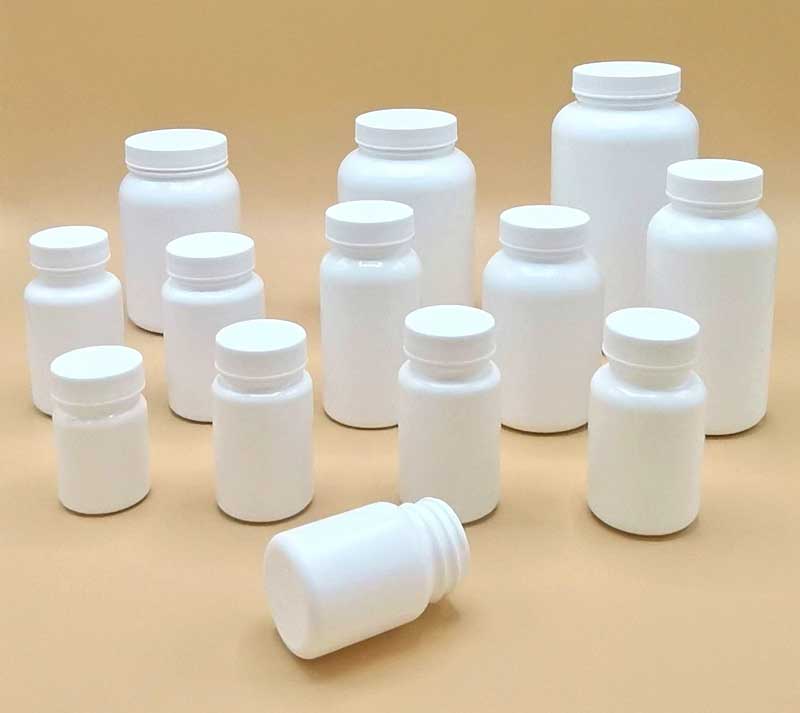
3. Lower Material Waste and Better Environmental Performance
Another advantage of IBM is its efficient material use.
In EBM, excess plastic often forms at the bottom or top of the container, creating scrap that must be trimmed off. This can account for a noticeable percentage of total material use, depending on product shape and machine setup.
IBM minimizes this issue because the injected preform is precisely designed for the final container shape. As a result:
- material waste is very low
- there is less post-processing
- production is cleaner
- recycling of production waste is reduced
This gives IBM both economic and environmental benefits, especially in industries where clean production and traceability are important.
4. Greater Compatibility with Medical-Grade Materials
Medical packaging materials must meet demanding requirements. They often need to be:
- biocompatible
- chemically stable
- resistant to sterilization
- transparent for visual inspection
- low in extractables and leachables
EBM is commonly used with materials such as:
- LDPE
- HDPE
These materials are useful in some applications, but they may have limitations in chemical resistance, oxygen barrier performance, and high-end medical compatibility.
IBM can process a wider range of medical-grade plastics, including:
- PE
- PP
- PET
- COC
- COP
These materials offer significant advantages:
- PP: good chemical resistance and sterilization resistance
- PET: clarity and strength
- COC/COP: excellent transparency, dimensional stability, and low extractables
This makes IBM suitable for high-value medical packaging such as:
- diagnostic containers
- pharmaceutical bottles
- injectable drug packaging
- laboratory sample containers
IBM also has the potential to support more advanced packaging solutions, including multi-layer structures for improved barrier performance.
5. Easier Regulatory Compliance
Medical packaging must satisfy strict regulations from authorities such as:
- FDA
- EMA
- other national medical and pharmaceutical agencies
Compliance requires:
- process repeatability
- stable product quality
- documentation of manufacturing parameters
- material traceability
- minimized contamination risk
IBM is highly advantageous in this area because the process is:
- repeatable
- automated
- easier to monitor
- easier to validate
Parameters such as temperature, pressure, and cycle time can be tightly controlled, which supports quality assurance and regulatory documentation.
By contrast, EBM’s greater dimensional variability and higher trimming/waste levels can make validation and compliance more difficult for critical medical applications.
IBM vs EBM: Which is Better for Medical Packaging?
Although EBM has advantages in producing:
- large containers
- irregular shapes
- lower-cost packaging for non-critical products
these strengths are less relevant for most medical packaging applications.
Medical packaging usually requires:
- small to medium container sizes
- standardized shapes
- precise neck finishes
- excellent sealing performance
- sterile production conditions
- high material consistency
For these reasons, IBM is generally the superior process for medical packaging.
Summary Comparison
| Item | Injection Blow Molding (IBM) | Extrusion Blow Molding (EBM) |
|---|---|---|
| Neck and thread precision | Excellent | Moderate to lower |
| Wall thickness uniformity | Excellent | Less consistent |
| Sterility control | Better | More contamination risk |
| Waste generation | Very low | Higher |
| Post-processing | Minimal | Often required |
| Material compatibility | Wide range of medical-grade materials | More limited |
| Regulatory compliance support | Strong | More challenging |
| Suitable medical applications | High-precision bottles, vials, diagnostic containers | Less critical or larger packaging |
The Development Prospects of IBM in the Field of Medical Packaging
As the medical industry continues to evolve, the demand for packaging with higher precision, better sterility control, and broader material compatibility is increasing rapidly.
Key trends driving the growth of IBM in medical packaging include:
- expansion of biologics and injectable drugs
- increased demand for diagnostic packaging
- stricter regulatory standards
- growth of personalized medicine
- demand for highly transparent and low-extractable packaging materials
- need for automated, contamination-free manufacturing
IBM is well positioned to meet these future demands because it combines precision engineering, automation, and medical-grade material adaptability.
In the coming years, IBM is expected to play an even more important role in:
- pharmaceutical primary packaging
- diagnostic consumables
- drug delivery system components
- sterile laboratory packaging
Application Cases of IBM in the Field of Medical Packaging
Injection Blow Molding is already widely used in a range of medical packaging applications, including:
1. Pharmaceutical Bottles
Used for oral liquid medicines, tablets, and capsules where precise neck finish and sealing reliability are essential.
2. Injectable Drug Containers
Suitable for high-precision packaging that must maintain sterility and dimensional consistency.
3. Diagnostic Reagent Bottles
Clear, uniform containers are required for reagent storage and visual inspection.
4. Laboratory and Sample Containers
IBM enables repeatable production of small, accurate containers used in clinical and testing environments.
5. Specialty Medical Containers
With materials such as COC and COP, IBM can support advanced medical and pharmaceutical packaging needs.
Conclusion
Both Injection Blow Molding and Extrusion Blow Molding are important manufacturing technologies, but their suitability depends on the packaging application.
For medical packaging, the priorities are clear:
- precision
- sterility
- consistency
- material performance
- regulatory compliance
In all of these areas, Injection Blow Molding offers significant advantages over Extrusion Blow Molding.
Its ability to produce highly accurate neck finishes, maintain a cleaner and more automated production process, reduce material waste, and process advanced medical-grade plastics makes it the preferred choice for many medical packaging applications.
As the demand for higher-quality pharmaceutical and diagnostic packaging continues to grow, IBM will remain one of the most important manufacturing processes in the medical packaging industry.