How Servo Systems Improve Stability in Injection Blow Molding Machines
Injection Blow Molding (IBM) is widely used in the production of pharmaceutical bottles, cosmetic containers, food packaging, and various precision plastic products. As market requirements continue to increase, manufacturers are placing greater emphasis on product consistency, dimensional accuracy, and production efficiency. One of the key technologies that has significantly enhanced machine performance in recent years is the servo drive system.
Compared with conventional hydraulic systems, servo-driven injection blow molding machines offer more precise control over movement, pressure, and speed. These advantages directly contribute to improved process stability and better product quality. In high-volume manufacturing environments, even minor fluctuations can lead to defects, material waste, and increased operating costs. Servo technology helps minimize these issues by ensuring repeatable and controlled machine operation.
1.Precise Motion Control for Consistent Production
Accurate Positioning During Critical Molding Stages
Injection blow molding involves several interconnected processes, including injection, core rod transfer, blow molding, and product ejection. Each stage requires precise movement and timing. Any deviation in position or speed may affect the final product.
Servo systems provide highly accurate positioning control through closed-loop feedback mechanisms. The motor continuously adjusts its output according to the machine’s operating conditions, ensuring that each movement follows the programmed parameters.
For example, during the injection stage, maintaining consistent screw movement and injection pressure is essential for forming uniform preforms. If the injection volume varies from cycle to cycle, wall thickness differences may occur, leading to quality issues in the finished bottle. Servo-driven systems help maintain stable injection performance, reducing such variations.
Servo systems provide highly accurate positioning control through closed-loop feedback mechanisms. The motor continuously adjusts its output according to the machine’s operating conditions, ensuring that each movement follows the programmed parameters.
For example, during the injection stage, maintaining consistent screw movement and injection pressure is essential for forming uniform preforms. If the injection volume varies from cycle to cycle, wall thickness differences may occur, leading to quality issues in the finished bottle. Servo-driven systems help maintain stable injection performance, reducing such variations.
Improved Repeatability Across Production Cycles
Many injection blow molding applications require extremely tight tolerances. Pharmaceutical and medical packaging products are particularly sensitive because dimensional deviations can affect filling, sealing, or labeling processes.
Servo systems improve cycle-to-cycle repeatability by maintaining stable operating conditions throughout production. Since the machine can reproduce the same motion profile repeatedly, manufacturers achieve greater consistency in bottle weight, neck finish dimensions, and overall product appearance.
This stability becomes especially valuable when producing small-volume containers such as eye drop bottles, oral liquid bottles, and laboratory packaging, where precision is critical.
Servo systems improve cycle-to-cycle repeatability by maintaining stable operating conditions throughout production. Since the machine can reproduce the same motion profile repeatedly, manufacturers achieve greater consistency in bottle weight, neck finish dimensions, and overall product appearance.
This stability becomes especially valuable when producing small-volume containers such as eye drop bottles, oral liquid bottles, and laboratory packaging, where precision is critical.
2. Stable Pressure and Speed Control Throughout the Process
Reducing Process Fluctuations
Traditional hydraulic systems often experience pressure fluctuations due to oil temperature changes, valve wear, and varying load conditions. These fluctuations can affect machine performance and introduce inconsistencies into the molding process.
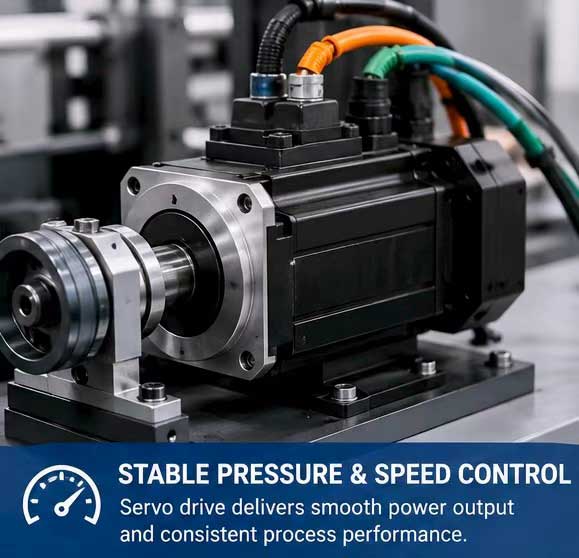
Servo-driven systems regulate pressure and speed more precisely. The motor only delivers the required power at each stage of the cycle, allowing smoother operation and reducing sudden changes in machine behavior.
In practical production, stable pressure control helps maintain uniform material flow during injection. Consistent material flow contributes to better preform quality and minimizes common defects such as short shots, flash, sink marks, and uneven wall distribution.
Servo-driven systems regulate pressure and speed more precisely. The motor only delivers the required power at each stage of the cycle, allowing smoother operation and reducing sudden changes in machine behavior.
In practical production, stable pressure control helps maintain uniform material flow during injection. Consistent material flow contributes to better preform quality and minimizes common defects such as short shots, flash, sink marks, and uneven wall distribution.
Better Control During Blow Molding
The blow molding stage is equally important for achieving high-quality containers. During blowing, the heated preform must expand evenly against the mold cavity to create the desired bottle shape.
Servo-controlled systems help ensure that mold movements and process timing remain synchronized.
Consistent operation allows the preform to be transferred and blown under stable conditions, reducing the risk of deformation or uneven stretching.
Manufacturers producing cosmetic bottles, pharmaceutical packaging, and specialty containers often rely on this level of stability to maintain attractive product appearance and consistent functional performance.
Servo-controlled systems help ensure that mold movements and process timing remain synchronized.
Consistent operation allows the preform to be transferred and blown under stable conditions, reducing the risk of deformation or uneven stretching.
Manufacturers producing cosmetic bottles, pharmaceutical packaging, and specialty containers often rely on this level of stability to maintain attractive product appearance and consistent functional performance.
3. Enhanced Machine Reliability and Reduced Operational Variations
Lower Mechanical Stress on Machine Components
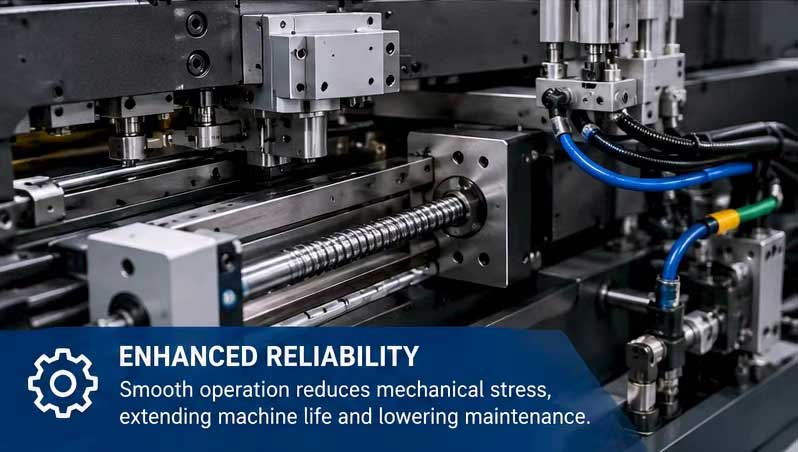
Smooth machine operation not only improves product quality but also extends equipment life. Servo systems accelerate and decelerate gradually, reducing sudden mechanical impacts on moving components.
In injection blow molding machines, parts such as transfer mechanisms, mold clamping systems, guide rails, and core rod assemblies experience repeated movement throughout the production process. Excessive vibration or impact can accelerate wear and lead to maintenance issues.
By providing controlled motion profiles, servo systems reduce mechanical stress and help maintain long-term machine accuracy. As a result, manufacturers often experience fewer unexpected shutdowns and more stable production schedules.
In injection blow molding machines, parts such as transfer mechanisms, mold clamping systems, guide rails, and core rod assemblies experience repeated movement throughout the production process. Excessive vibration or impact can accelerate wear and lead to maintenance issues.
By providing controlled motion profiles, servo systems reduce mechanical stress and help maintain long-term machine accuracy. As a result, manufacturers often experience fewer unexpected shutdowns and more stable production schedules.
Consistent Performance Under Different Production Conditions
Injection blow molding facilities frequently process different materials and product designs.
Switching between production runs can challenge machine stability if operating conditions change significantly.
Servo systems adapt quickly to varying process requirements. Whether producing small pharmaceutical bottles or larger cosmetic containers, the machine can maintain accurate speed and pressure control according to the selected recipe.
This flexibility allows manufacturers to achieve stable production across a wider range of applications while minimizing setup adjustments and trial runs. Faster changeovers also contribute to higher overall equipment utilization.
Switching between production runs can challenge machine stability if operating conditions change significantly.
Servo systems adapt quickly to varying process requirements. Whether producing small pharmaceutical bottles or larger cosmetic containers, the machine can maintain accurate speed and pressure control according to the selected recipe.
This flexibility allows manufacturers to achieve stable production across a wider range of applications while minimizing setup adjustments and trial runs. Faster changeovers also contribute to higher overall equipment utilization.
Supporting Long-Term Quality Improvement
Product quality depends not only on mold design and raw materials but also on process stability. A stable machine creates a stable process, and a stable process produces consistent products.
Servo technology helps manufacturers establish repeatable operating conditions that can be maintained over long production periods. This consistency reduces quality variation, improves yield rates, and simplifies process optimization efforts.
In highly regulated industries such as pharmaceutical packaging, maintaining consistent product quality is essential. Servo-driven injection blow molding machines provide the level of control needed to support strict production standards and quality requirements.
Servo technology helps manufacturers establish repeatable operating conditions that can be maintained over long production periods. This consistency reduces quality variation, improves yield rates, and simplifies process optimization efforts.
In highly regulated industries such as pharmaceutical packaging, maintaining consistent product quality is essential. Servo-driven injection blow molding machines provide the level of control needed to support strict production standards and quality requirements.
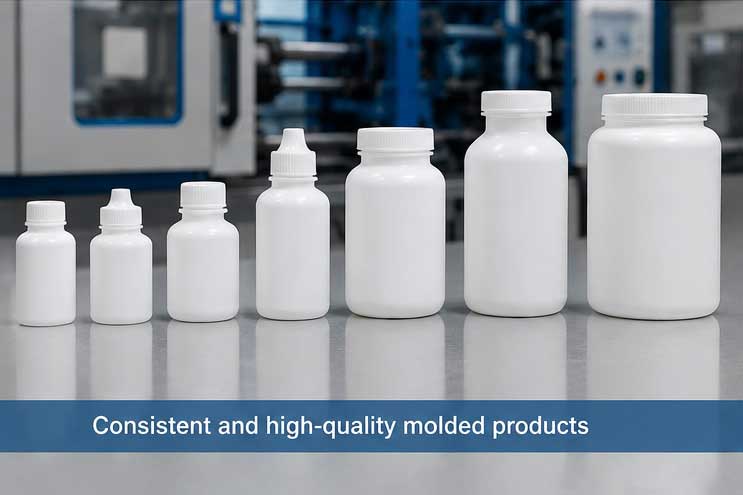
Servo systems have become an important advancement in modern injection blow molding technology. By providing precise motion control, stable pressure regulation, and highly repeatable machine performance, servo-driven machines significantly improve production stability.
In practical injection blow molding applications, these benefits translate into more consistent bottle quality, reduced process variation, lower equipment wear, and improved manufacturing efficiency. Whether producing pharmaceutical containers, cosmetic packaging, or food-grade bottles, manufacturers can achieve greater reliability and tighter quality control through the use of servo technology.
As product quality requirements continue to rise, servo systems will remain a key factor in helping injection blow molding operations achieve stable, efficient, and dependable production performance.
In practical injection blow molding applications, these benefits translate into more consistent bottle quality, reduced process variation, lower equipment wear, and improved manufacturing efficiency. Whether producing pharmaceutical containers, cosmetic packaging, or food-grade bottles, manufacturers can achieve greater reliability and tighter quality control through the use of servo technology.
As product quality requirements continue to rise, servo systems will remain a key factor in helping injection blow molding operations achieve stable, efficient, and dependable production performance.